Why Every Service Business Needs a Funnel (Not Just a Website)
A client came to me once with a website she was genuinely proud of. And honestly? It was beautiful. Clean layout, professional photos, thoughtful color palette. She’d invested real time and money into it.
But when I asked how many leads it had generated in the last three months, she went quiet. The answer was two. Maybe three.
She wasn’t doing anything wrong. Her website looked great. Her services were clearly listed. She had a contact form. She was sharing the link everywhere.
The problem wasn’t the website. The problem was that a website alone isn’t a growth strategy. It’s a piece of one.
The Difference Between a Website and a Funnel
Think of your website as a storefront window. People walk by, glance in, maybe appreciate what they see. Some might even walk through the door.
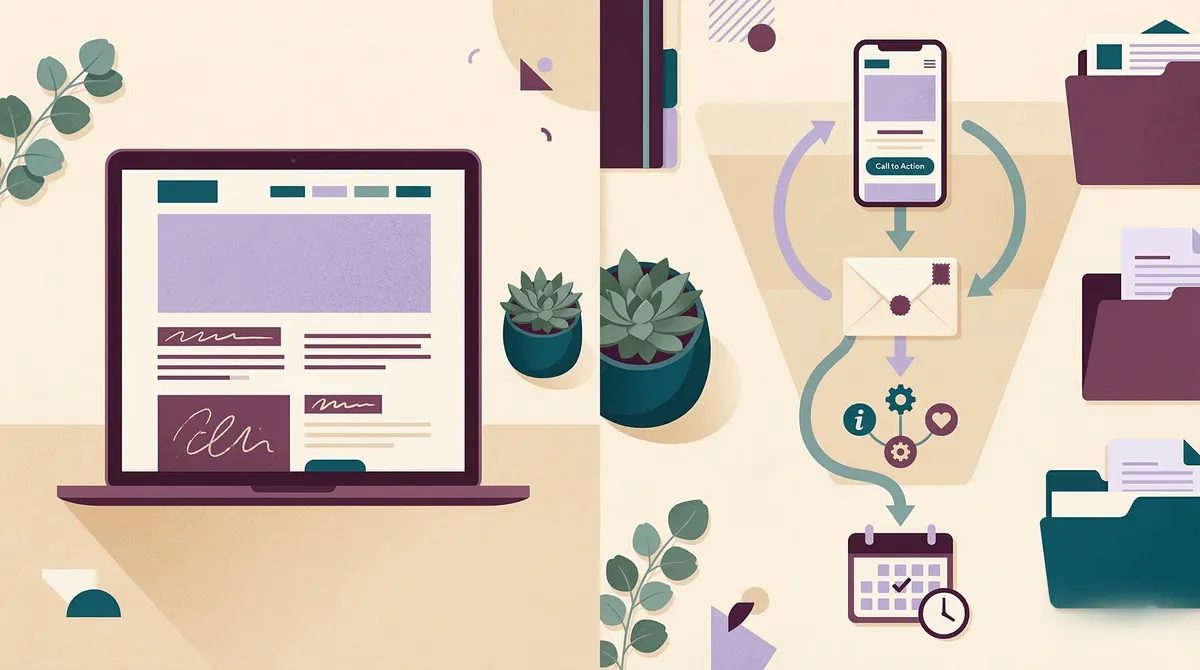
A funnel is what happens once they’re inside. It’s the intentional path you create — the one that takes someone from “I just found you” to “I’m ready to work with you.” Step by step. No guessing. No hoping they’ll figure it out on their own.
A website says: “Here’s everything about me.”
A funnel says: “Here’s exactly what to do next.”
What a Funnel Actually Looks Like
It doesn’t have to be complicated. Here’s a simple one that works for most service businesses:
- Lead Magnet — A free resource that solves a small, real problem (a checklist, a guide, a template)
- Email Nurture — A short sequence that builds trust and positions you as someone who understands their world
- Offer Page — A clear page that presents your service with a strong call to action
- Booking Flow — A frictionless way to schedule and pay
Each step has one job: move the person to the next step. No sidebar distractions. No “while you’re here, check out our blog.” Just a clear path forward.
That client I mentioned? She had all the ingredients scattered across her website. Testimonials on one page. Services on another. A contact form buried at the bottom. But nothing connected. No path. Visitors had to do the work of figuring out where to go and what to do — and most of them didn’t bother.
Why Most Websites Don’t Convert
The biggest pattern I see: too many options, not enough direction.
Your homepage has a nav bar with six links, a blog feed, social media icons, and a footer full of more links. Where should someone go first? When everything is equally important, nothing feels urgent.
A funnel eliminates that decision fatigue. Instead of hoping someone clicks the right thing, you guide them. One step at a time.
This isn’t about tricking people or being pushy. It’s about respecting their time. They came to your site because they have a problem. A good funnel helps them solve it faster.
You Don’t Have to Choose One or the Other
Here’s the part people miss: you need both. They just serve different purposes.
- Your website is for credibility, SEO, and people who are already looking for you by name
- Your funnel is for conversion — turning strangers into subscribers, and subscribers into clients
The real power is when they work together. Your blog post ranks on Google. Someone finds it, clicks through to a lead magnet. That triggers an email sequence. Three emails later, they book a discovery call.
That’s not luck. That’s a system. And it runs whether you’re online or not.
What This Looked Like for That Client
After we mapped out a simple funnel — one lead magnet, a five-email nurture sequence, and a clear services page with one call to action — her lead flow changed within weeks. Not because she started doing more. Because the work she’d already done finally had a path to follow.
She didn’t scrap her website. We just gave it a job.
The Bottom Line
If you’re relying on your website alone to bring in clients, you’re counting on people to do the work for you. Some will. Most won’t.
A funnel doesn’t replace your website. It gives your website a spine. A clear, guided path that moves people from curious to committed — and gives you something you can actually measure and improve.